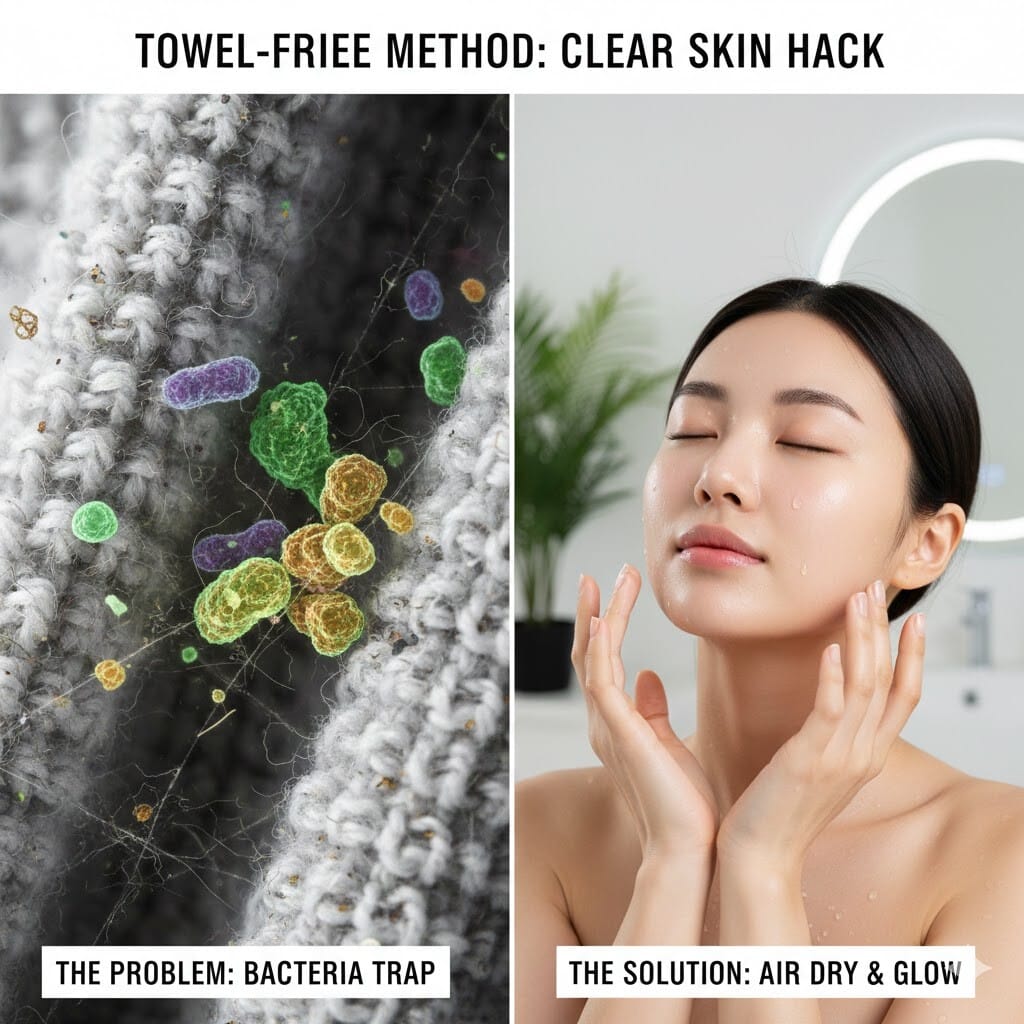
You invest in expensive cleansers, religiously apply salicylic acid, and change your pillowcases weekly. Yet, every morning, you wake up to a new, angry red bump on your cheek. You are doing everything right—or so you think. But there is one step in your routine that might be sabotaging all your hard work, and it is the one step you probably never suspected: drying your face.
What if I told you that the fluffy cotton towel hanging in your bathroom is actually a biological weapon against your clear skin?
Welcome to the “Towel-Free Method,” the zero-cost skincare hack that is taking the acne community by storm. It is not a product; it is a lifestyle change. By simply removing towels from your regimen, thousands of acne sufferers are finally breaking the cycle of breakouts. Today, we are diving deep into why your towel is the enemy, the science behind bacteria breeding, and exactly how to master the art of air-drying for a flawless complexion.
The Hidden Danger: Why Your Towel is a Bacteria Trap
Let’s be honest. When was the last time you washed your bathroom hand towel? Two days ago? Three? Even if you wash it daily, a towel is, by design, the perfect incubator for bacteria.
1. The “Petri Dish” Effect Bathroom environments are typically warm and humid—the ideal conditions for microbial growth. When you wipe your face and leave the damp towel on the rack, you are creating a five-star hotel for bacteria like Staphylococcus aureus and Propionibacterium acnes (the bacteria responsible for acne). Even if a towel smells clean, it can harbor millions of fungal spores and dead skin cells. When you use that towel again, you are essentially rubbing yesterday’s dirt and bacteria back onto your freshly cleansed pores.
2. Micro-Tears and Friction Acne-prone skin is inflamed and sensitive. The loop-pile texture of a standard terry cloth towel might feel soft to your hands, but on a microscopic level, it can be abrasive to inflamed skin. Vigorously rubbing your face dry causes “micro-tears” in the skin barrier. This physical irritation, known as Acne Mechanica, exacerbates existing breakouts and can spread infection from one part of your face to another.
3. The Detergent Dilemma It is not just the towel itself; it is what you wash it with. Fabric softeners and dryer sheets leave a waxy residue on fibers to make them feel fluffy. When this residue transfers to your face, it can clog pores (comedogenic) and trigger allergic reactions or contact dermatitis, which often looks exactly like fungal acne.
What is the “Towel-Free” Method?
The concept is simple: Do not let a reusable cloth towel touch your face.
Instead of drying your face with a towel after cleansing, you allow your skin to air dry or use a single-use, biodegradable option. This eliminates the risk of bacterial transfer, physical friction, and chemical irritation in one fell swoop. It is the ultimate “subtractive” skincare method—you aren’t adding a new product; you are removing a harmful variable.
Step-by-Step Guide: How to Execute the Towel-Free Routine
Ready to ditch the towel? Here is the correct way to implement this method into your daily AM and PM routine for maximum results.
Step 1: The “Clean Hands” Rule Before you even touch your face or your cleanser, wash your hands thoroughly with antibacterial soap. This sounds basic, but many people skip it. You do not want the bacteria from your phone screen or door handle transferring to your face.
Step 2: Cleanse Gently Use your preferred acne-safe cleanser. Massage it in for at least 60 seconds to break down oil and debris. Rinse with lukewarm water—never hot, as heat strips the skin’s natural oils and can trigger more sebum production.
Step 3: The “Shake” Technique (Air Drying) Here is where the magic happens. Once you have rinsed your face, do not reach for the towel. Instead, gently shake your hands to remove excess water, then stand upright and let the water drip off your face for about 10 to 15 seconds. You can gently fan your face with your hands to speed up the process.
Step 4: The “Damp Skin” Application This is a crucial pro-tip. You do not need your face to be bone dry. In fact, applying your toner, essence, or moisturizer while your skin is still slightly damp significantly boosts hydration. Hyaluronic acid and glycerin work by trapping moisture; if you apply them on damp skin, they lock in that extra water, leaving your skin plumper and more hydrated than if you applied them to a dry face.
Step 5: The Tissue Alternative (Optional) If you are in a rush and cannot wait for air drying, use a disposable facial tissue or a specialized “clean skin towel” (biodegradable viscose wipes). Gently pat—do not rub—the water off. Ensure you use a high-quality tissue that does not leave lint behind.
The Unexpected Benefits of Going Towel-Free
Beyond just reducing acne, this method transforms your skin health in several ways.
- Restored Skin Barrier: By eliminating the physical friction of rubbing, your skin barrier has a chance to heal. Redness and irritation often subside within a week.
- Increased Product Efficacy: As mentioned, applying products to damp skin enhances absorption. You might find that you need less moisturizer to achieve the same level of hydration.
- Mental Clarity: There is a psychological benefit to knowing your routine is 100% hygienic. You no longer have to wonder, “Is this towel clean?” You eliminate that variable entirely.
Honestly, ditching the towel was the low-key game changer my routine desperately needed.
It sounds like hyperbole, but for many, this small tweak yields better results than a $100 serum.
Common Myths About Air Drying
- Myth: “Water evaporating from the face dries out the skin.”
- Truth: This is only true if you let your skin dry completely and wait too long before applying moisturizer. If you apply your skincare while the skin is still damp (within 30 seconds), you actually increase hydration.
- Myth: “It takes too long.”
- Truth: It takes about 30 extra seconds. You can use this time to brush your teeth, put in your contact lenses, or simply breathe.
- Myth: “Paper towels are wasteful.”
- Truth: This is a valid concern. If you are eco-conscious, stick to the strict “Air Dry” method (no tissues). Or, look for 100% bamboo or cotton disposable towels that are biodegradable and compostable.
When Should You Expect Results?
Skincare is a marathon, not a sprint. However, because the Towel-Free Method removes an immediate daily agitator, many users report seeing a reduction in new active breakouts within 7 to 14 days.
The first thing you will notice is a reduction in redness. Without the abrasive friction of a towel, your post-cleansing face will look calmer and less blotchy. Over time, as the bacterial load on your skin decreases, you should see fewer pustules (whiteheads) and deep cysts.
Integrating with Your Current Routine
The beauty of this method is that it works with any skincare philosophy. Whether you are using a 10-step K-Beauty routine or a simple 3-step medical regimen, going towel-free does not interfere with your products.
However, remember that consistency is key. You cannot use a dirty towel on weekends and expect the method to work. If you must use a towel (perhaps at a gym or hotel), bring your own single-use tissues or ensure the towel is fresh out of the dryer.
If you are looking for more comprehensive guides on how to repair your skin barrier or choose the right cleanser for this method, be sure to check out https://cosemeticsworld.com/. We have a treasure trove of tips designed to help you navigate the confusing world of skincare ingredients.
Conclusion: A Small Change for Massive Gains
Sometimes, the best solution isn’t adding more; it is doing less. The The “Towel-Free” Method challenges the ingrained habit of towel-drying, forcing us to look at the hygiene of our most basic tools.
If you have been fighting a losing battle with acne, try this method for just two weeks. It costs nothing, requires no new products, and might just be the missing puzzle piece in your journey to clear skin. Stop feeding the bacteria, stop scrubbing your sensitive barrier, and let the air do the work. Your skin will thank you.