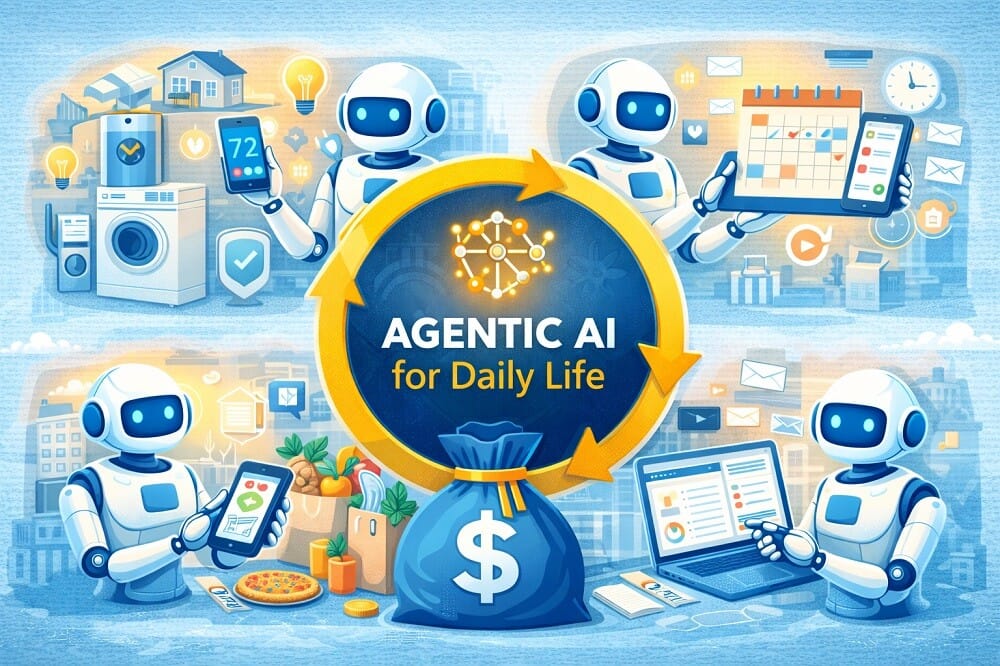
Artificial intelligence is no longer limited to answering questions or analyzing data in isolated tasks. A newer concept, often described as “agentic AI,” refers to systems that can take initiative, plan actions, and pursue goals with limited human input. As this idea becomes more visible, many people are curious about what agentic AI actually means for everyday life.
From an everyday explanations perspective, agentic AI does not represent science fiction or fully independent machines. Instead, it describes a shift in how AI systems operate, moving from passive tools to more proactive digital assistants. Understanding this shift helps clarify why agentic AI is increasingly discussed in relation to daily routines, work patterns, and digital environments.
Agentic AI refers to systems that can act toward goals autonomously.
Agentic AI is commonly defined by its ability to initiate actions rather than waiting for direct commands. Traditional AI systems respond when prompted, such as generating text or classifying images. In contrast, agentic systems are designed to observe conditions, decide on next steps, and act within defined boundaries.
This autonomy does not mean unlimited freedom. Agentic AI typically operates under constraints set by developers, organizations, or users. These constraints guide what goals the system can pursue and how it can interact with its environment. The result is an AI that appears more independent while remaining controlled.
In daily life, this distinction matters because it changes how people interact with technology. Instead of issuing repeated instructions, users may rely on systems that manage tasks continuously in the background. This shift alters expectations about efficiency and convenience in digital tools.
Everyday tasks are increasingly shaped by proactive AI behavior.
Agentic AI is most noticeable when it manages routine activities.
- The system monitors information relevant to a task.
- It identifies when action is needed based on predefined goals.
- It selects an appropriate response or sequence of steps.
- It executes actions without requiring constant user input.
Examples of this pattern can be seen in digital scheduling, smart home environments, and automated workflows. Rather than waiting for a command, the system anticipates needs based on context. This anticipation is what differentiates agentic behavior from simple automation.
As these systems become more common, daily interactions with technology may feel smoother and less fragmented. Tasks that once required multiple steps can be handled continuously, reducing the need for manual oversight. This change reflects a broader trend toward background intelligence rather than visible commands.
Decision-making frameworks define how agentic AI behaves.
The behavior of agentic AI depends heavily on how its decision-making framework is designed.
- Goals define what the system is trying to achieve.
- Rules establish boundaries and priorities.
- Feedback mechanisms allow adjustment over time.
- Evaluation processes determine whether actions are effective.
These frameworks ensure that agentic AI remains predictable and aligned with its intended purpose. Without structure, autonomous behavior could become inefficient or inconsistent. With structure, autonomy becomes a tool for reliability rather than risk.
In everyday contexts, these frameworks help explain why agentic AI often feels subtle. The system is not constantly visible because its decisions are guided toward maintaining normal conditions. Only when a change is needed does its activity become noticeable.
Agentic AI changes how people relate to digital tools.
As AI systems become more agentic, the relationship between users and technology evolves. Instead of managing tools directly, people increasingly supervise outcomes. This shift moves interaction from task execution to goal oversight.
This change can affect how time and attention are distributed. When systems handle routine decisions, individuals can focus on higher-level planning or creative work. The perceived benefit is not speed alone, but reduced cognitive load.
However, this also introduces new considerations. Trust becomes central, as users rely on systems to act appropriately without constant confirmation. Understanding how and why agentic AI makes decisions becomes an important part of digital literacy.
Limitations and safeguards shape real-world use.
Despite its growing presence, agentic AI is not without limitations.
- Systems rely on the quality of available data.
- Goals must be clearly defined to avoid misalignment.
- Oversight mechanisms are required to prevent unintended behavior.
- Transparency affects user confidence and acceptance.
These factors ensure that agentic AI remains supportive rather than disruptive. In daily life, most implementations are intentionally conservative. They prioritize stability and predictability over experimentation.
This cautious approach explains why agentic AI often appears incremental. Instead of dramatic changes, users experience gradual improvements in convenience and coordination. The technology integrates quietly into existing routines.
Social and practical implications emerge over time.
As agentic AI becomes more widespread, its impact extends beyond individual tasks. Systems that act autonomously influence how organizations operate, how services are delivered, and how expectations are formed. Over time, this can reshape norms around responsiveness and availability.
In daily life, these changes are subtle but cumulative. People may come to expect systems that manage schedules, resources, and information continuously. This expectation influences how technology is evaluated and adopted.
Understanding agentic AI as a process rather than a product helps explain its gradual influence. It represents an evolution in system behavior, not a single invention or feature.
Conclusion
Agentic AI for daily life refers to AI systems that can initiate and manage actions in pursuit of defined goals. Rather than replacing human decision-making, these systems aim to reduce friction in routine tasks through structured autonomy. Viewing agentic AI through an everyday explanations lens clarifies why it is becoming more common and how it fits into existing digital environments.
As technology continues to evolve, agentic AI is likely to remain a background presence rather than a dramatic disruption. Its influence lies in how it reshapes interactions, expectations, and efficiency over time. Understanding this concept helps readers interpret emerging AI tools with greater clarity and realism.