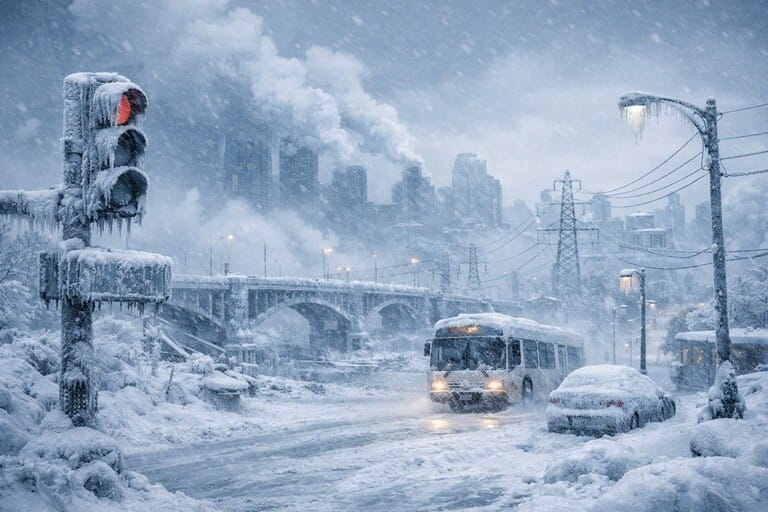
Extreme cold events have become a recurring topic in global news, especially during winters marked by severe Arctic air outbreaks. Temperatures reaching -50°F are no longer just abstract numbers on a weather map; they represent real conditions that disrupt daily life, infrastructure, and basic human safety. When a winter storm reaches this level of intensity, the risks extend far beyond discomfort and quickly become life-threatening without proper understanding.
This guide explains what -50°F conditions actually mean, why storms like Winter Storm Fern attract widespread attention, and how extreme cold affects the human body and modern living systems. Rather than focusing on emergency instructions or personal advice, the goal is to provide a clear, foundational explanation of the concepts behind extreme cold survival in a way that everyday readers can understand.
What -50°F really represents
At -50°F, the environment behaves very differently from what most people consider “cold.” Air at this temperature can cause exposed skin to freeze within minutes, not because of wind alone, but due to rapid heat transfer from the body to the surrounding air. Even common materials such as metal, plastic, and rubber change physical properties, becoming brittle and prone to failure.
Extreme cold also alters how the atmosphere feels and functions. Moisture in the air is minimal, making breathing feel sharp and dry. Fuel thickens, batteries lose efficiency, and mechanical systems struggle to operate. These conditions explain why severe cold snaps often lead to transportation shutdowns, power disruptions, and widespread closures, even in regions accustomed to winter weather.
From a broader perspective, -50°F highlights the limits of human adaptation. Modern buildings, clothing systems, and energy networks are designed around certain temperature thresholds. When those thresholds are exceeded, survival depends less on convenience and more on basic thermal physics and insulation principles.
Why extreme winter storms gain global attention
Winter storms like Fern become major news stories not only due to low temperatures but because of their scale and persistence. These systems often affect large geographic areas simultaneously, placing strain on emergency services, supply chains, and energy infrastructure. A prolonged period of extreme cold can lead to cascading failures that amplify its overall impact.
Public interest also increases because extreme cold events challenge assumptions about climate stability. While individual storms do not define long-term climate trends, their intensity raises questions about atmospheric circulation patterns, polar vortex behavior, and weather variability. This broader context turns a single storm into a reference point for scientific and public discussion.
Another reason for heightened attention is the universal vulnerability involved. Unlike localized hazards, extreme cold affects urban centers, rural areas, and critical services at the same time. Understanding the mechanics behind such storms helps explain why preparation and awareness are emphasized by governments and meteorological agencies.
How the human body responds to extreme cold
In -50°F conditions, the human body prioritizes core temperature above all else. Blood flow to the skin and extremities is reduced to conserve heat, which increases the risk of frostbite in fingers, toes, ears, and the nose. This physiological response is automatic and occurs regardless of individual tolerance or experience with cold weather.
Prolonged exposure also increases the likelihood of hypothermia, a condition where the body loses heat faster than it can produce it. At extremely low temperatures, this process accelerates, even with layered clothing. The danger lies in how quickly body heat can dissipate when insulation is compromised by wind, moisture, or inadequate materials.
Importantly, extreme cold affects cognitive function as well. Reduced blood flow and energy expenditure can impair judgment and reaction time. This explains why cold-related incidents often involve confusion or delayed responses, emphasizing that survival in such environments is as much about understanding limitations as it is about endurance.
How infrastructure is challenged by -50°F conditions
Modern infrastructure is highly sensitive to extreme cold. Water systems can freeze despite insulation, causing pipe bursts and service interruptions. Electrical grids face increased demand while components operate less efficiently, increasing the risk of outages. Transportation systems experience mechanical failures, reduced traction, and safety limitations.
Buildings also behave differently under these conditions. Heat loss accelerates through poorly insulated surfaces, and condensation can lead to ice formation inside structural elements. These factors help explain why authorities often issue shelter and conservation advisories during severe cold events, even in technologically advanced regions.
From an informational standpoint, these failures are not sudden or mysterious. They are predictable outcomes of physical laws applied under extreme conditions. Understanding this helps contextualize why extreme winter storms are treated as systemic challenges rather than isolated weather inconveniences.
Why preparedness information focuses on basics
Survival guidance for extreme cold consistently emphasizes fundamental principles such as insulation, reduced exposure, and heat retention. This is because, at very low temperatures, complex solutions often fail before simple ones. Layered barriers, controlled environments, and minimized heat loss remain effective regardless of technological context.
Educational resources from public institutions focus on explaining risks rather than offering guarantees. This approach reflects the reality that no single action ensures safety in -50°F conditions. Instead, awareness of how cold affects the body and surroundings allows individuals and communities to make informed decisions within their specific circumstances.
For authoritative background on cold weather safety and environmental risks, general guidance is provided by agencies such as the U.S. National Weather Service, which explains the science and dangers of extreme cold events in accessible terms: https://www.weather.gov/safety/cold
Conclusion
Surviving -50°F conditions is not about heroism or endurance but about understanding how extreme cold fundamentally alters the environment, the human body, and modern systems. Winter storms like Fern capture attention because they expose the thin margin between routine winter weather and conditions that challenge basic safety.
By focusing on concepts rather than instructions, this guide highlights why extreme cold is treated as a serious hazard worldwide. Awareness of the mechanisms behind such temperatures helps explain public warnings, infrastructure responses, and the growing interest in winter preparedness as a matter of shared knowledge rather than individual experience.