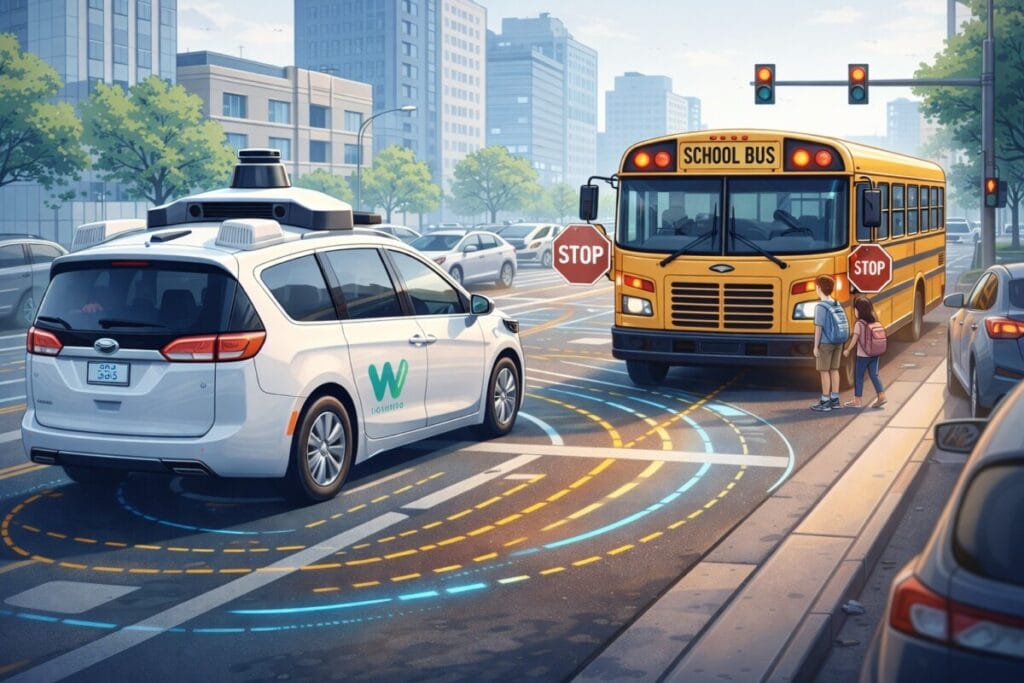
Autonomous vehicles have increasingly moved from controlled testing environments into real-world city streets across the United States. Robotaxi services are designed to operate without human drivers, relying on sensors, software, and machine learning to navigate complex traffic situations. As these services expand, interactions with traditional road users have become a central focus of public and regulatory attention.
The investigation into Waymo robotaxi incidents involving school buses in Austin highlights how autonomous systems are evaluated when unexpected or sensitive situations arise. Rather than focusing on individual outcomes, such investigations aim to understand system behavior, safety standards, and how emerging technologies align with existing traffic laws.
Why school bus safety is a critical issue
School buses are subject to strict traffic rules in the United States because they transport children, who are considered especially vulnerable road users. When a school bus stops to pick up or drop off passengers, surrounding traffic is typically required to stop, regardless of direction. These rules are designed to create a predictable and protected environment.
For autonomous vehicles, school bus scenarios present technical challenges that go beyond standard traffic interactions. Visual signals such as flashing lights, extended stop arms, and varying bus designs must be correctly identified and interpreted in real time. Any hesitation or misinterpretation can raise safety concerns, even if no collision occurs.
Because of this, incidents involving school buses are treated with heightened scrutiny. Regulators view these cases as important indicators of whether autonomous driving systems can reliably handle legally sensitive and safety-critical situations in everyday traffic.
What prompted the Austin investigation
Reports from Austin indicated that robotaxis operated by Waymo did not always respond as expected when encountering stopped school buses. In some situations, vehicles were reported to slow down or pause instead of fully stopping, prompting questions about compliance with traffic laws.
Such reports do not automatically imply widespread malfunction. Urban driving environments are highly variable, with differences in lighting, road markings, bus configurations, and surrounding traffic behavior. These factors can create complex edge cases for automated systems.
Investigations typically examine sensor data, software decision-making processes, and operational policies to determine whether behavior aligns with legal requirements. The goal is to identify whether adjustments are needed to improve consistency and safety before broader deployment continues.
How investigations influence autonomous vehicle oversight
In the United States, autonomous vehicle safety investigations are part of an ongoing oversight process rather than a one-time response. Agencies such as the National Highway Traffic Safety Administration monitor vehicle performance and have authority to request information, evaluate risks, and recommend corrective actions.
These investigations help establish expectations for how autonomous systems should behave in complex scenarios. Instead of halting innovation entirely, regulators often focus on incremental improvements, transparency, and accountability. This approach allows technology to evolve while maintaining public safety standards.
General information about how vehicle safety investigations are conducted and how traffic safety laws are enforced is available through official government sources such as https://www.nhtsa.gov. These resources explain regulatory processes without focusing on individual enforcement outcomes.
Conclusion
The Waymo robotaxi investigation in Austin illustrates the challenges of integrating autonomous vehicles into real-world traffic systems. School bus interactions, in particular, serve as a critical test of whether self-driving technology can meet long-established safety expectations.
By examining these incidents through formal investigations, regulators and developers gain insight into system limitations and areas for improvement. Understanding this process helps clarify how autonomous vehicle safety is evaluated and why such cases play an important role in shaping future transportation policies.